Monday, September 14, 2026

What “Counts” as Educational Policy? By Jean Aynon

 Aynon argues that external factors can influence a child’s education just as much as internal factors. In the text, Aynon discusses policies that have been put in place with the intention of improving education for lower-class students and students living in urban neighborhoods. However, many of these policies have failed because they do not fully consider the environment that these children are growing up in. A child’s education can be affected by many things outside of the classroom, such as their living conditions, access to transportation, and the job opportunities available to their families and communities. Aynon argues that we do not only need better schools, we also need to reform the policies that prevent urban communities from having access to the resources and opportunities necessary for a proper education. By addressing issues such as housing, transportation, and employment, communities can create an environment where children have a better chance of succeeding in school and beyond. 
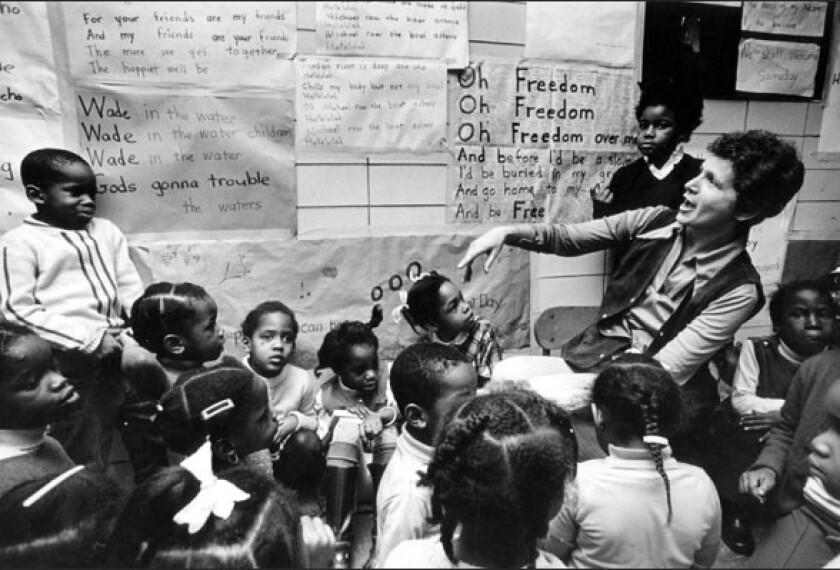
On the Front Lines in the War on Poverty (Opinion)


“I would argue that the improvement is relative and illusory.” If you were to compare how many students continue their education after fifth grade to how many students continue their education today, there has been a very significant increase. However, Aynon argues that this improvement may not be as meaningful as it appears. In 1900, students could decide not to continue their education after fifth grade and still be able to find a job that could eventually lead to a middle-class income. Today, however, the situation is very different. Few students in urban communities continue their education past the ninth grade, and graduation rates in large inner-city high schools are extremely low. For many low-income students, obtaining a college degree has become much more important because it is often necessary to qualify for a decent-paying job that could potentially help them reach the middle class. As Aynon points out, “only 7 percent obtain a bachelor's degree by age twenty-six (Education Trust, 2001; Mishel, Bernstein, & Schmitt, 2001).” This shows how urban school districts are failing to provide many of their students with the education and opportunities they need to succeed. Although more students are continuing their education today than in the past, Aynon argues that the consequences of educational inequality are far more serious now because students without a high school or college education have fewer opportunities to achieve financial stability and move into the middle class.


In class I would want to talk about how these outside factors that outside of students control truly affects their education. And what kind of policies can we put in place to assist these students. 


AI was used to polish up. 


Tuesday, September 8, 2026

Blog Post #2 The Broken Model By Salman Khan

 Mary Astell says that "ignorance and a narrow education lay the foundation of vice, and imitation and custom rear it up." Khan uses this quote to set up his main argument, our educational system isn't inevitable or natural; it's something that's been constructed and carried on over a long history. He goes on to show that a lot of our educational customs aren't still around because they work well, but because they've become so ingrained in us that we don't think to question them. The three quotes I've chosen reveal how Khan builds this case throughout the chapter.


"Things that are now considered orthodox were at various points regarded as controversial and radical." At one point, the schooling system wasn't the way it is now, and the idea of changing it was controversial. But over time, the new system became the norm. People stopped questioning it and just went along with it because that's what everyone else was doing. This connects back to the Astell quote at the beginning of the chapter, where she says that imitation and custom "rear it up” meaning they build up and sustain these systems. And she's right. When everyone is following the same system, who wants to be the one person going against the grain?


Help Your Child Deal With School and Academic Anxiety | Strong4Life


"It has tenure." The current schooling system has been around for 150 to 190 years. People's lives have been built around this system. Careers exist just to maintain it. It has ingrained itself so deeply into society that even thinking about changing it feels like it would cause a major disturbance. Some people might also have an "if it's not broken, don't fix it" mindset when it comes to education. This relates to the text because Khan is arguing that just because something has been around for a long time doesn't mean it's working well. He points out that the system was designed for a different era, one that needed obedient workers, not creative thinkers. But the world has changed, and the system hasn't kept up. We hold onto these customs out of habit and fear of disruption, not because they're actually preparing students for the world they'll inherit.


In class, I would like to discuss the tendency to believe that the educational system has to be there for us to function properly as a society. Khan points out that we treat the system as if it's inevitable, but it's really just something we've gotten used to. I think this is worth talking about because it shows how much we rely on habit and fear when it comes to big institutions. Why do we assume that without this specific system, everything would fall apart? Are there other ways we could educate people that we haven't even considered because we're so stuck in this one model? I'd be curious to hear what others think about whether our attachment to the system is really about what works or just about what feels safe and familiar.


This is a slam poetry video that this text reminded me of.

https://youtu.be/ZcBix3sUmXk?si=7fVJNZ8wOnM_TVty


AI was used to give an outline and revise work. 


Tuesday, September 1, 2026

Blog Post #1- Privilege Power and Difference By Allan Johnson

Allan Johnson argues that the greatest barrier to change is simply how easy it is for people who benefit most from the system to do nothing, especially since talking about the problem would force them to sit with the uncomfortable truth that their privilege is at the expense of others. 

It is easier for people to act as if societal problems don’t exist because engaging with them can feel like taking blame and guilt for something they didn’t personally cause. But it also means they have to acknowledge the privilege in their lives, something they have done nothing to earn and, in turn recognize that their unearned advantage often comes at the expense of others who equally did nothing to deserve their suffering. "Everything that's done to receive or maintain it (privilege)-however passive and unconscious- results in suffering and deprivation for someone." 

Privilege and power in the workplace

The author proceeds to talk about the defensiveness and uncomfortableness that follows the use of words that name the differences and mistreatment of others, like how some men become defensive when sexism is mentioned as if it’s a dig to their personal character or an accusation same thing rings true for the other “isms”, but as Johnson says we cannot begin to address the issue without first naming it. “The bottom line is that a trouble we can’t talk about is a trouble we can’t do anything about.” 

What I truly think Johnson was trying to get at through is this: yes, these conversations are uncomfortable. Yes, they require you to hold up a mirror and take a deeper look at what's there. But in the end, if we can all commit to doing the introspective work, the discomfort can be worth it, and maybe then, one day, we can all just get along.

In class I want to talk about the Johnson saying trouble we can't talk about is trouble we can't do anything about. Words are powerful and we sometimes forget that and I want to have deeper discussion on that and how we can use our voices to make a difference in today's world. 

AI was only used to polish up sentences and make them more concise.   


What “Counts” as Educational Policy? By Jean Aynon

  Aynon argues that external factors can influence a child’s education just as much as internal factors. In the text, Aynon discusses polici...